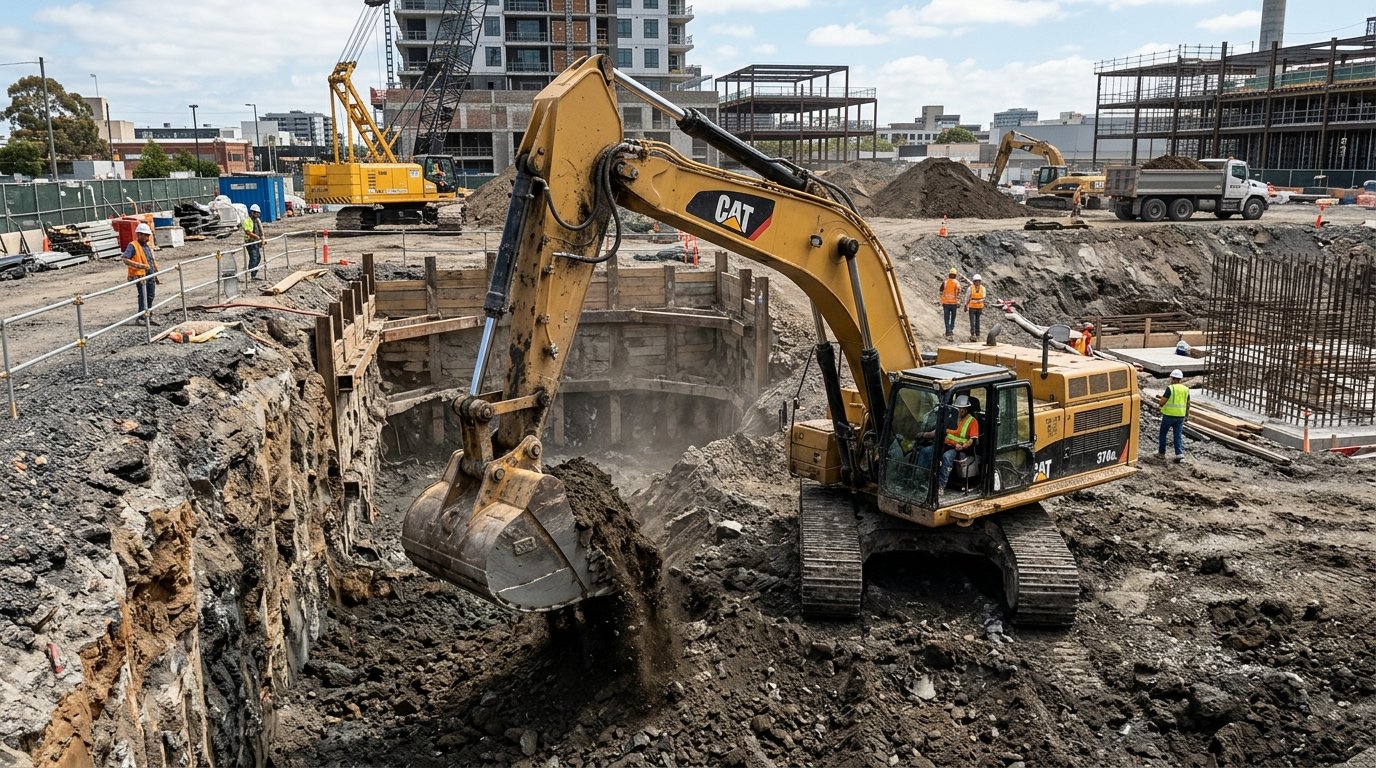
Geotechnical Engineering Calculator: Soil Bearing Capacity & Foundation Design Guide
Geotechnical engineering is the branch of civil engineering that deals with the behaviour of earth materials (soil and rock) and their interaction with structures. Every building, bridge, dam, and road depends on sound geotechnical analysis. Understanding soil bearing capacity, soil classification, and foundation depth selection is critical for safe and economical construction.
1. Soil Classification (IS 1498)
IS 1498: Classification and Identification of Soils for General Engineering Purposes uses the Unified Soil Classification System (USCS). Key categories: Gravel (G): GW (well-graded), GP (poorly graded); Sand (S): SW, SP; Silt (M): ML (low plasticity), MH (high plasticity); Clay (C): CL (lean clay), CH (fat clay/black cotton soil); Organic (O): OL, OH; Peat (Pt). The plasticity characteristics (Atterberg limits — Liquid Limit, Plastic Limit, Plasticity Index) define the silt-clay boundary.
2. Safe Bearing Capacity (SBC) of Soils
| Soil Type | SBC (kN/m²) |
|---|
| Soft clay / marshy / made-up ground | 50–100 |
| Medium clay / loose sand | 100–200 |
| Dense sand / firm clay | 200–400 |
| Dense gravel / very stiff clay | 400–600 |
| Soft / weathered rock | 600–1500 |
| Hard rock (granite, basalt) | 3000–10000 |
3. Terzaghi’s Ultimate Bearing Capacity
Terzaghi (1943) developed the fundamental equation for shallow foundation ultimate bearing capacity:
qu = c·Nc + q·Nq + 0.5·γ·B·Nγ
where: c = cohesion of soil (kN/m²); q = surcharge pressure = γ·Df (overburden); γ = unit weight of soil (typically 16–20 kN/m³); B = foundation width (m); Df = depth of foundation; Nc, Nq, Nγ = Terzaghi’s bearing capacity factors (functions of soil friction angle φ).
Safe bearing capacity qsafe = qu / FOS (Factor of Safety). IS 6403 recommends FOS = 2.5 for general shear failure; 3.0 for local shear failure conditions (loose sand, soft clay).
4. Standard Penetration Test (SPT)
The SPT (IS 2131) is the most widely used in-situ soil investigation test. A split-spoon sampler is driven 450mm by a 63.5kg hammer falling 760mm. The N-value (blow count for last 300mm) correlates to soil properties: N=0–4 (very loose sand/very soft clay); N=4–10 (loose/soft); N=10–30 (medium dense/firm); N=30–50 (dense/stiff); N>50 (very dense/hard/rock).
5. Frequently Asked Questions
Q1: What is the minimum depth for a house foundation?
IS 1904: Minimum depth = 0.5m below natural ground level for non-expansive soils. For black cotton (expansive) soil: minimum 1.5–2.0m below natural ground level to reach stable soil below the seasonal moisture fluctuation zone.
Q2: How do I identify black cotton soil?
Black cotton soil (Vertisol) is typically dark grey to black, has high clay content (>40%), shrinks and cracks in dry season and swells significantly when wet (volume change 15–45%). It has high plasticity (LL > 50%, PI > 35%). It poses significant challenges for foundations due to differential movement.
Q3: What is a soil investigation report and is it mandatory?
A soil investigation report (geotechnical investigation report) includes borehole logs, lab test results (grain size, Atterberg limits, consolidation tests, triaxial tests), bearing capacity, and foundation recommendations. It is mandatory for all buildings above G+3 and strongly recommended for all construction. NBC 2016 requires soil investigation for buildings over 10m height.
Q4: When should pile foundations be used?
Piles are required when: (a) soft/weak soil extends too deep for shallow foundations, (b) building loads are very heavy, (c) differential settlement must be controlled, (d) uplift forces must be resisted (tall buildings in wind), (e) construction is over water or in flood zones, or (f) seismic zone considerations require deep foundation.
Q5: What is the difference between isolated footing and raft foundation?
Isolated footing: individual footing under each column; suitable for good bearing capacity soil with adequate spacing. Raft (mat) foundation: one large slab covering the full building footprint; used when soil bearing capacity is low or column loads are heavy, as the raft distributes load over maximum area.
Q6: How does water table affect foundation design?
High water table reduces effective soil weight (submerged unit weight ≈ γsat − γw ≈ 10 kN/m³ vs dry 16–20 kN/m³), reducing bearing capacity. It also creates uplift pressure on foundations. Buoyancy check must be done for basements and underground structures: net uplift = water pressure − dead weight of structure above.
Q7: What is soil compaction and why is it needed?
Compaction is mechanical densification of soil by removing air voids. Done using rollers, rammers, or plate compactors. Properly compacted fill achieves: higher bearing capacity, lower settlement, reduced permeability, and better stability. IS 2720 Part 7 (Proctor test) determines Maximum Dry Density (MDD) and Optimum Moisture Content (OMC). Construction fill must achieve minimum 95% of MDD.
Q8: What is settlement of a foundation?
Settlement is the downward movement of a foundation under load. Types: Immediate (elastic) settlement — occurs as load is applied; Consolidation settlement — long-term, as water drains from clay; Secondary compression — very long-term creep. Maximum permissible differential settlement for framed buildings: 25mm (IS 1904). Excessive differential settlement causes tilting, cracking, and structural distress.
Q9: What is the allowable bearing pressure?
Allowable bearing pressure (q_allowable) = Ultimate bearing capacity / Factor of Safety. The lower of the bearing capacity-based value and settlement-based value governs. For residential buildings in India, 100–200 kN/m² is typical for most soil conditions (translating to column loads of 300–1500 kN on 1.5×1.5m to 2.5×2.5m footings).
Q10: What is the IS code for foundation design?
Key IS codes: IS 1904 — Code of Practice for Design & Construction of Foundations in Soils; IS 6403 — Determination of Allowable Bearing Pressure; IS 2911 Series — Design and Construction of Pile Foundations; IS 1888 — Method for Load Test on Soils.